
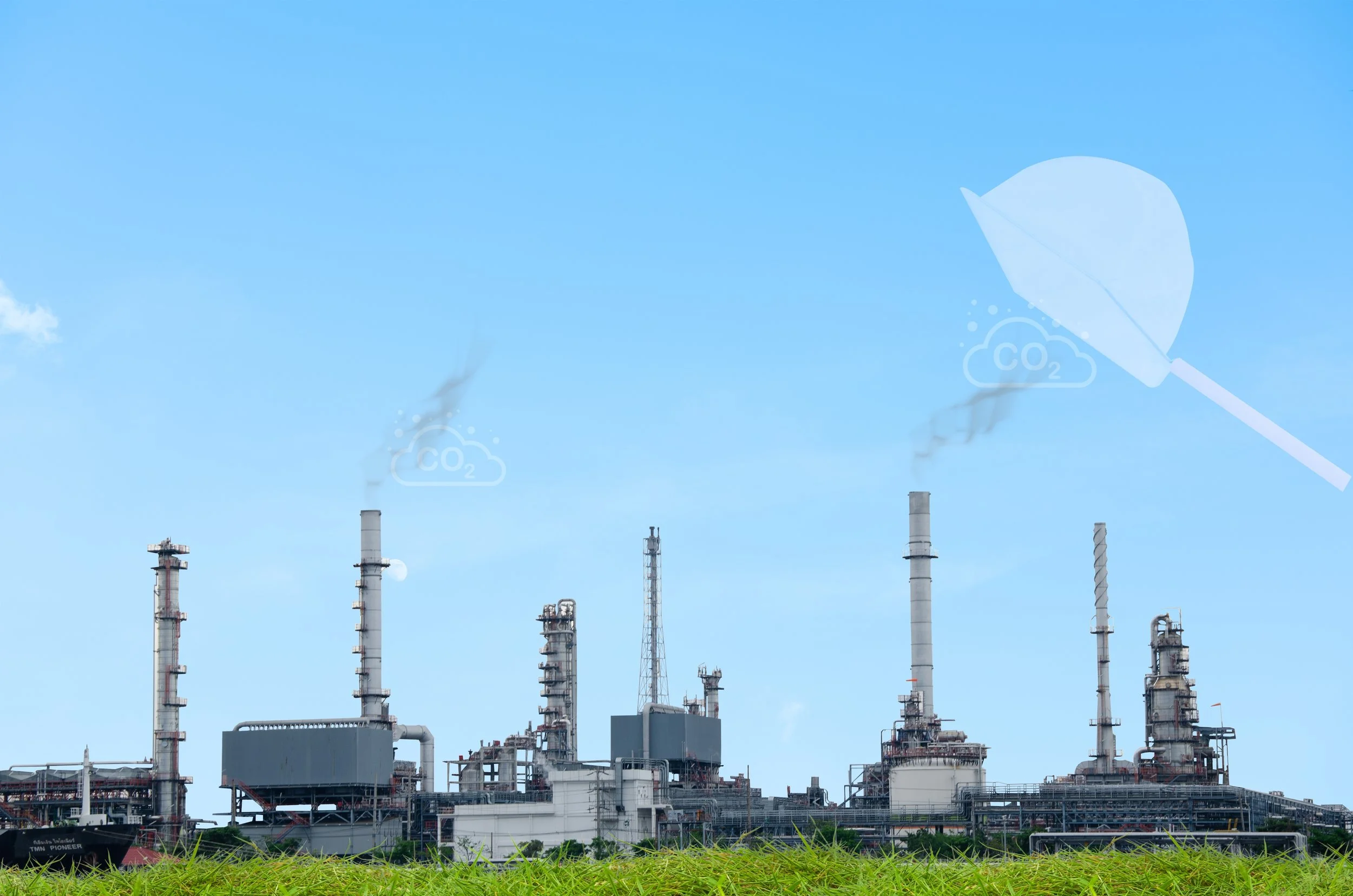
Industrial carbon capture is often presented as a facility-level technology. A cement plant, ethanol facility, refinery, power plant, or hydrogen facility adds capture equipment, separates CO₂ from an exhaust stream, and reduces its reported emissions.
For communities, the capture equipment is only the beginning.
Captured CO₂ has to be compressed, transported, stored, monitored, and governed. That makes industrial carbon capture not just a climate technology, but an infrastructure system.
EPA describes geologic sequestration as the long-term underground storage of CO₂ in deep rock formations. EPA’s Class VI well program regulates wells used to inject CO₂ for long-term storage, with a focus on protecting underground sources of drinking water. Class VI requirements include site characterization, modeling of the CO₂ plume and pressure front, review of existing wells in the area of review, corrosion-resistant well construction, monitoring, reporting, and post-injection responsibilities.
Those requirements matter because storage is not automatic. A geologic formation has to be able to receive CO₂, contain it, and protect drinking water resources. The site-specific questions include reservoir depth, pressure, porosity, caprock integrity, faulting, induced seismicity, existing wells, groundwater protection, and long-term plume movement.
Transport is just as important
The United States already has CO₂ pipeline infrastructure, but a much larger carbon management system would require a major expansion. PHMSA’s 2024 data show 5,345 miles in the “CO₂ or other” hazardous liquid pipeline category. PHMSA has also noted that CO₂ pipeline mileage could increase by as much as tenfold by 2050 if carbon capture and storage infrastructure expands.
For local governments and counties, that means carbon capture may show up not only as an industrial facility issue, but also as a land use, emergency management, transportation corridor, agricultural land, public safety, and community engagement issue.
CO₂ pipelines raise different safety questions than natural gas pipelines. CO₂ is not managed primarily as a fire or explosion risk. The concern is that a major release can create a dense plume, displace oxygen, and create emergency response challenges, especially in low-lying areas. PHMSA’s 2025 proposed rule specifically addressed lessons from the 2020 Satartia, Mississippi CO₂ pipeline failure and proposed requirements for emergency responder training, CO₂ detection equipment, stronger public communication, and more detailed vapor dispersion analysis.
Those requirements should be treated as a planning signal. A community along a proposed CO₂ route should not be asked to rely on broad assurances. It should have access to specific information about routing, shutoff valves, plume modeling, emergency response capacity, public notification, responder training, and who pays for preparedness.
The question of infrastructure affects climate accounting
A facility may claim a carbon reduction when CO₂ is captured, but the climate benefit depends on the full chain. How much CO₂ is captured? How much additional energy is required? What fuel powers the capture system? Where is the CO₂ transported? Is it permanently stored, used in a product, or used for enhanced oil recovery? How is leakage risk monitored? Who is liable after injection stops?
The International Energy Agency reports that global operational CO₂ capture and storage capacity was just over 50 million metric tons as of the first quarter of 2025, while the current project pipeline could reach about 430 million metric tons per year of capture capacity by 2030. That is meaningful growth, but it also shows that the infrastructure system is still small compared with the scale of global emissions and the gigaton-scale storage assumed in many models.
DOE’s carbon management “Liftoff” materials identify transport and storage bottlenecks, permitting, siting, community buy-in, revenue certainty, and challenging project economics in hard-to-decarbonize sectors such as cement, steel, refining, and chemicals.
The Bottom Line for Carbon Capture for Climate Planning Teams
For municipal, county, and state planning teams, the practical conclusion is clear: industrial carbon capture should be evaluated as a full-chain system. The capture equipment, pipeline route, storage site, monitoring plan, emergency response system, community benefits, lifecycle emissions, and long-term responsibility all matter.
A carbon capture project is not credible because CO₂ is captured. It is credible only if the whole system reduces net emissions, protects communities, manages risk, and remains accountable over time.