
Communities are increasingly asked to evaluate carbon capture, carbon removal, carbon offsets, tree planting, soil carbon, reforestation, prairie restoration, wetland protection, and industrial carbon storage at the same time. These topics are related, but they are not interchangeable.
A carbon management hierarchy can help planning teams sort them out
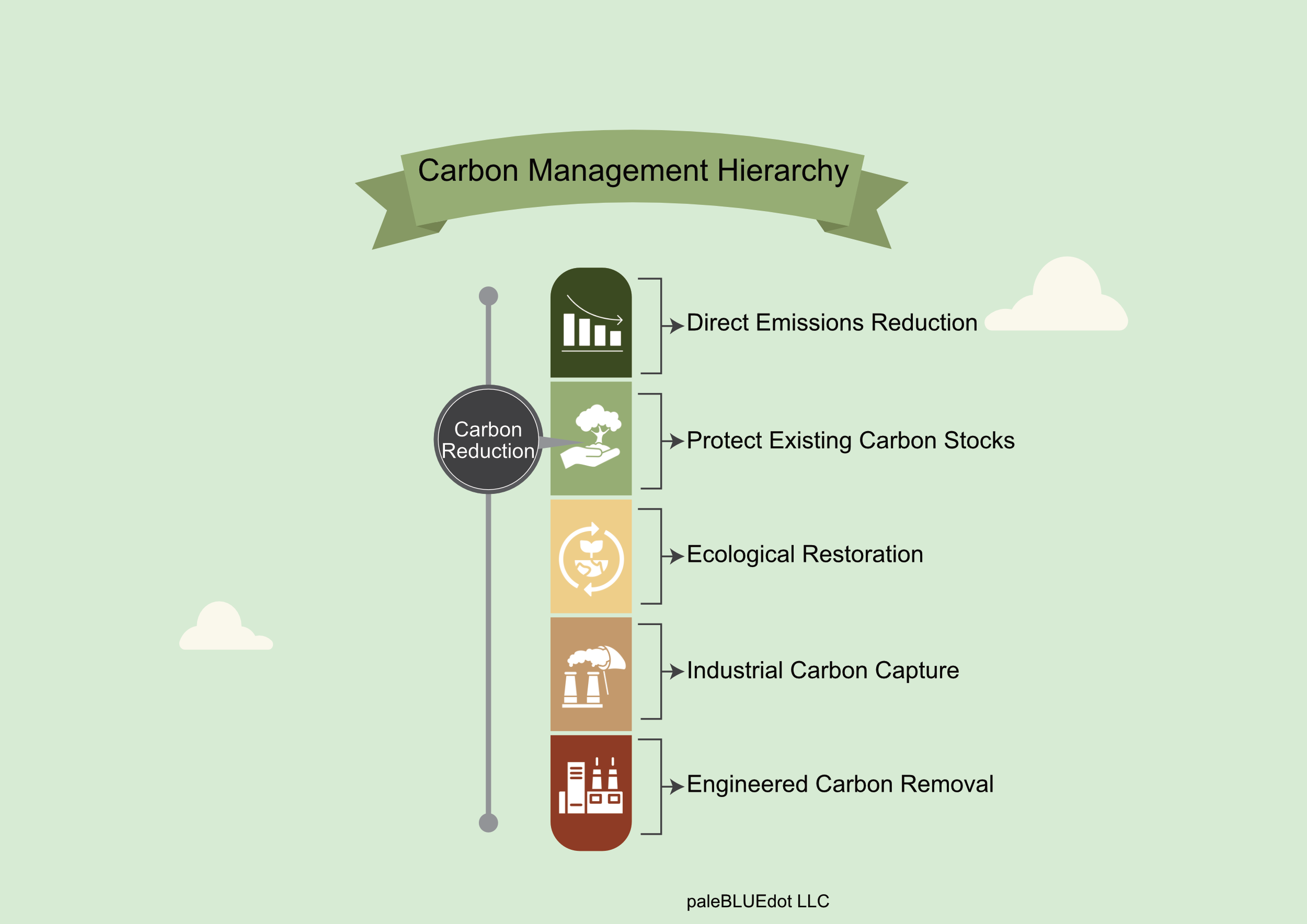
The first level is direct emissions reduction. This is the foundation of credible climate planning. Reduce energy use. Electrify buildings and vehicles. Use renewable electricity. Reduce vehicle miles traveled. Improve transit, biking, walking, and land use. Reduce methane. Prevent waste. Improve water and wastewater efficiency. Shift public procurement toward lower-carbon materials and practices. These actions reduce emissions before carbon enters the atmosphere. They should carry the most weight in a public climate plan.
The second level is protection of existing carbon stocks. Before counting new carbon storage, communities should protect the carbon already stored in forests, wetlands, prairies, soils, and green spaces. Avoiding the loss of existing carbon stocks is often more reliable than assuming new plantings will make up for land conversion later. Protecting existing ecosystems can also preserve habitat, reduce flood risk, protect water quality, and maintain community resilience.
The third level is ecological restoration and improved land management. This includes reforestation where forest is ecologically appropriate, prairie and savanna restoration where grassland systems are appropriate, wetland restoration, riparian buffers, urban tree canopy expansion, soil health practices, and turf-to-native conversions. EPA’s greenhouse gas inventory recognizes the role of forests, vegetation, and soils as carbon sinks, while the IPCC emphasizes that land-based mitigation can provide significant opportunities and co-benefits when implemented carefully.
The fourth level is industrial carbon capture for hard-to-eliminate emissions. Some emissions may remain difficult to eliminate even after efficiency, electrification, material substitution, process changes, and demand reduction. In those cases, carbon capture may be worth evaluating. But the burden of proof should be high. A project should show why the emissions cannot be avoided, where the CO₂ will go, how it will be stored, what the lifecycle emissions are, who monitors it, who is responsible for long-term risk, and how affected communities are involved.
The fifth level is engineered carbon dioxide removal. Direct air capture, biomass carbon removal and storage, enhanced mineralization, and other removal pathways may become more important over time, especially for residual emissions. The National Academies describes negative emissions technologies as approaches that remove CO₂ directly from the atmosphere or enhance natural carbon sinks, distinguishing them from point-source capture at large facilities. The US Department of Energy similarly includes direct air capture, soil carbon sequestration, biomass carbon removal, enhanced mineralization, ocean-based removal, and afforestation/reforestation within carbon dioxide removal.
The final level is offsets and external credits. These should be used cautiously, if at all, in public-sector climate plans. Offsets can raise questions about additionality, permanence, leakage, double counting, local benefit, and equity. If used, they should be reported separately from direct local reductions and should not be the main strategy for meeting community climate goals.
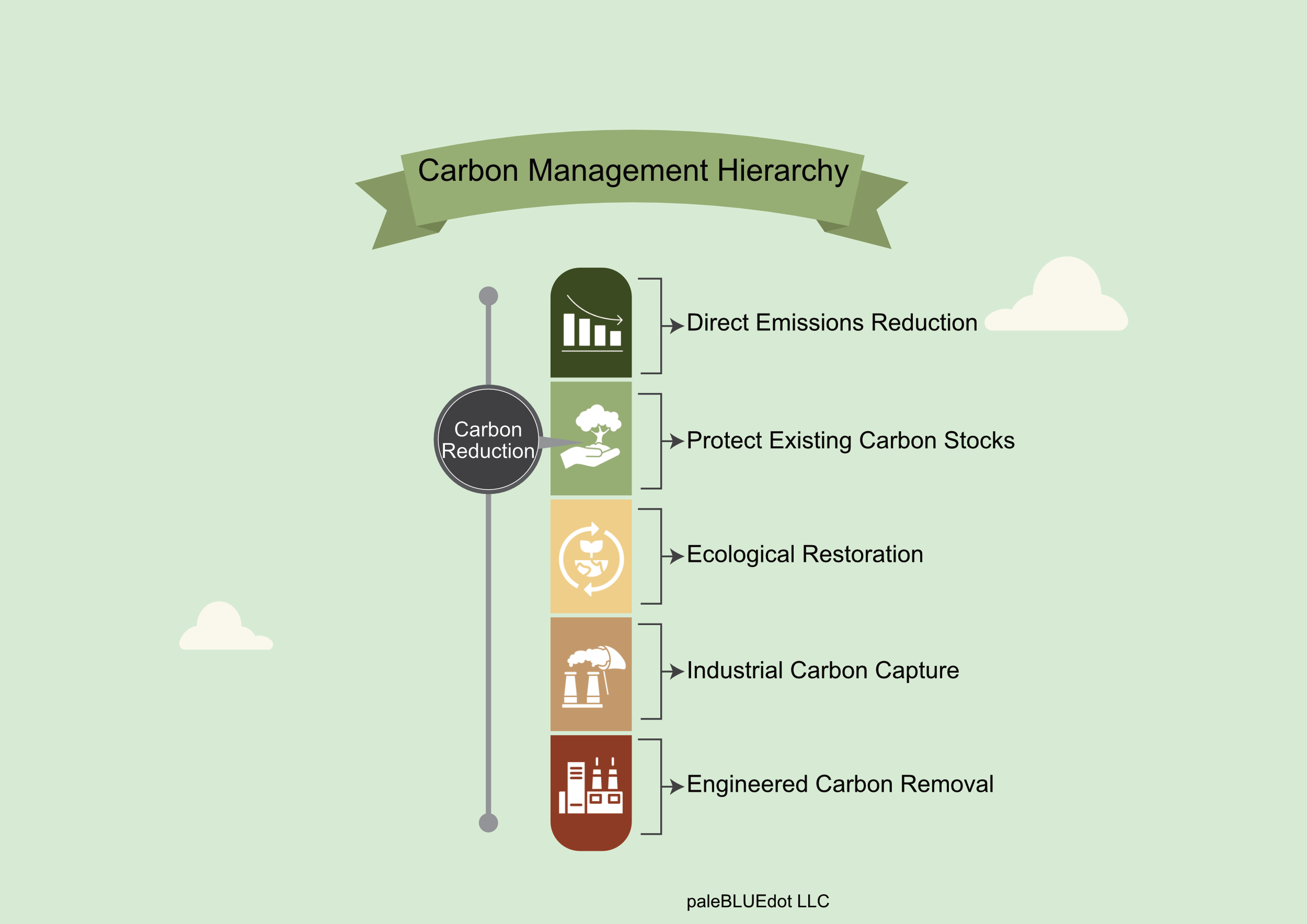
The paleBLUEdot Carbon Management Hierarchy
This hierarchy helps planning teams avoid two common mistakes
The first mistake is treating all carbon-related actions as equal. They are not. Direct emissions reductions, biological sequestration, industrial capture, direct air removal, and offsets have different timelines, risks, evidence standards, and community impacts.
The second mistake is using future carbon capture or carbon removal to weaken near-term action. The IPCC notes that carbon dioxide removal can be important for achieving net-zero emissions, especially to counterbalance residual emissions, but it is not a substitute for deep emissions reductions.
For municipal, county, and state governments, carbon management should be approached as a portfolio, but not a flat portfolio. The highest priority should be actions that avoid emissions and reduce local risk now. Biological sequestration should be valued for carbon, resilience, health, water, and biodiversity benefits. Industrial capture and engineered removals should be reserved for clearly justified applications with strong accounting and governance. Offsets should be transparent, conservative, and separate from direct reductions.
Putting Each Carbon Tool in Its Proper Place
The goal is not to choose between technology and nature. The goal is to put each tool in its proper place.
A strong climate plan should show which actions reduce emissions directly, which protect existing carbon, which increase biological storage, which rely on industrial capture, and which involve external credits or removals. Combining all of these into one vague “carbon neutral” claim can make a plan look stronger while making accountability weaker.
The safest carbon management hierarchy is simple: reduce first, protect second, restore third, capture only where necessary, remove only where credible, and offset only with caution.