

For many state and metropolitan climate teams, June 1, 2026 marked an important shift. EPA’s Climate Pollution Reduction Grants planning program required Comprehensive Climate Action Plans from states and metropolitan statistical areas by that date, following earlier Priority Climate Action Plans and implementation grant applications.
As a result, many public entities now have updated greenhouse gas inventories, priority measures, stakeholder input, benefit descriptions, and a clearer understanding of sector-specific opportunities. These are important accomplishments. They represent months, and in many cases years, of coordination across departments, agencies, community partners, and residents.
But many communities still face a practical question: now what?
The next major accountability point is the CPRG Status Report, due at the close of the four-year planning grant period in mid-2027. That report will ask communities to demonstrate progress, identify barriers, and explain how the plan has moved toward implementation. Communities cannot wait until the report is due to determine whether their climate plan has become operational.
From Planning to Action
A Comprehensive Climate Action Plan is designed to guide long-term work. That makes it a strong public-facing document, but it can also make the plan difficult to use in day-to-day staff decision-making.
A public works director, finance officer, county engineer, planning commission, facilities manager, or community partner may not be able to take a broad climate measure and immediately know what to do next. The next phase is translation: turning adopted or submitted climate measures into department-owned workplans, capital project scopes, engagement commitments, and funding-ready project descriptions.
This is where implementation structure becomes essential.
A useful implementation approach should help staff answer basic questions: Who owns this measure? What decisions need to happen next? What funding could support it? Which partners should be involved? What benefits should be tracked? What barriers are likely to arise? How will progress be documented?
In our work at paleBLUEdot, this typically takes the form of an Implementation Matrix that serves as both a workplan and a progress tracker. This tool can support an internal implementation team that meets regularly to coordinate across departments, resolve barriers, and keep momentum moving from planning into action.
The timing in establishing and firming up your implementation structure matters. Plan development often creates energy, visibility, and relationships that can fade if implementation is not organized quickly. The funding environment also continues to move. Municipal budgets, federal funding notices, state programs, utility incentives, and philanthropic opportunities rarely align neatly with planning timelines. If a climate measure remains only a paragraph in a plan, staff may not be ready when a grant opens, a capital project advances, or a partner asks how they can help.
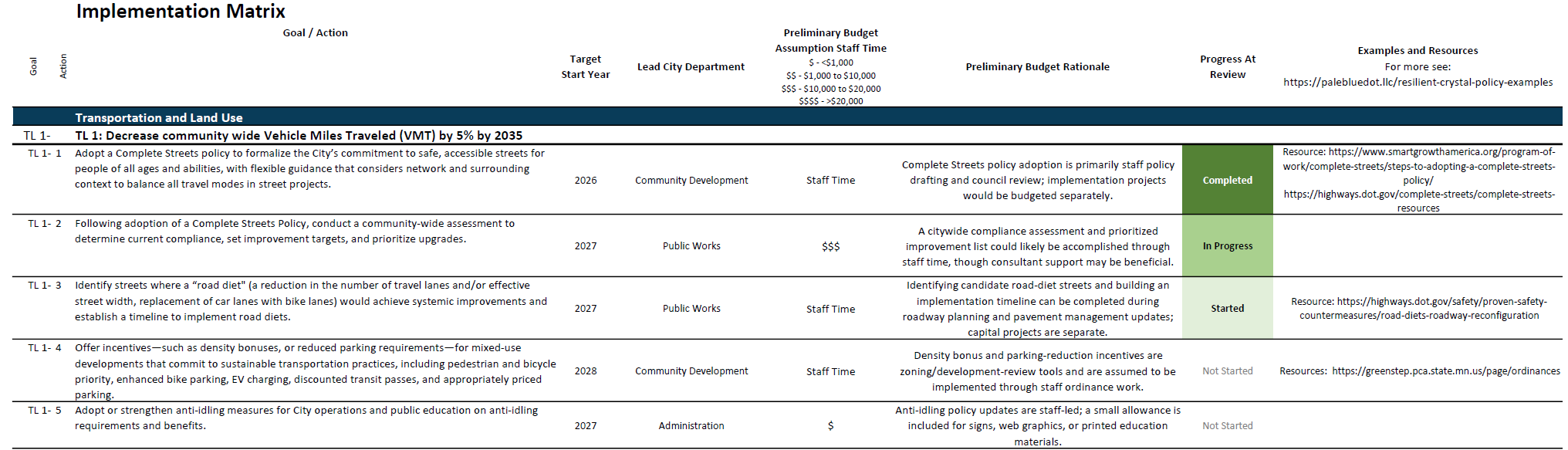
Example paleBLUEdot Implementation Matrix
What an Implementation Workplan Should Include
A post-CCAP implementation workplan does not need to be overly complicated, but it should be clear enough to guide real decisions.
At a minimum, it should identify each measure, the lead department, supporting departments, partner organizations, near-term decision points, estimated budget needs, likely funding sources, equity considerations, emissions or resilience benefits, and potential implementation partners. It should also distinguish between actions that can begin with existing staff capacity and actions that require outside funding, procurement, formal council action, or additional technical support.
This distinction is important. Some actions can move forward immediately through staff coordination, internal policy updates, or integration into existing projects. Others require larger capital planning, public engagement, intergovernmental agreements, or new funding. A strong workplan helps staff see the difference.
With an implementation workplan in place, teams can begin by selecting a small number of measures that are both important and movable. These early actions can build confidence, demonstrate progress, and create systems that support larger efforts over time.
For example, a building energy measure may need facility benchmarking, a list of candidate buildings, utility data agreements, and a connection to the capital improvement plan. A transportation measure may need coordination with a safe streets action plan, transit-oriented development process, fleet replacement schedule, or regional transportation plan. A waste or materials measure may need procurement language, hauler conversations, site analysis, or partnership development before it can appear in a budget.
Regional organizations have an especially important role to play. Many regional CCAP measures are too large or interconnected for one jurisdiction to implement alone. Regional clean transportation, shared composting infrastructure, building workforce development, and large-scale renewable energy strategies all require coordination across boundaries. In these cases, the next step may not be ten separate city workplans. Instead, an integrated implementation structure that establishes and supports bringing together a partner table with clear roles, shared timelines, and a common understanding of who is responsible for moving each piece forward.
Implementation Takeaways
Treat the CCAP as a launch document. Build a measure-by-measure implementation tracker that is useful to staff, not just to grant reporting.
Assign ownership carefully. A sustainability or climate office can coordinate, but many actions belong in public works, finance, facilities, planning, housing, economic development, utilities, or regional agencies.
Write project scopes early. A grant-ready climate project usually needs a location, beneficiaries, cost range, implementation partner, timeline, match strategy, and evidence of community benefit.
Keep engagement commitments visible. If residents, community organizations, or partner agencies helped shape the plan, the implementation tracker should show where their input went, what decisions remain open, and how they will continue to be involved.
Use reporting as a management tool. CPRG status reporting will be easier if the community has already built the habit of documenting progress, barriers, decisions, and next steps.
Implementation Architecture That Moves Plans Forward
The period after CCAP submission is a critical implementation window. Communities now have stronger climate measures, clearer priorities, and a foundation for action. The challenge is turning that foundation into systems that staff, partners, elected officials, and residents can use.
That means moving from broad measures to specific assignments. It means connecting climate priorities to capital planning, budgeting, procurement, engagement, grant strategy, and departmental workplans. It also means creating a practical way to track progress before the next reporting deadline arrives.
Climate plans are most effective when they do more than describe what should happen. They need to help communities organize how the work will happen, who will carry it forward, and what steps come next.